النص الأصلي
النص الكامل
By Ahmed Yehia Hamdalla — Partner, SAT & Co. Advocates and Legal Consultants, Dubai
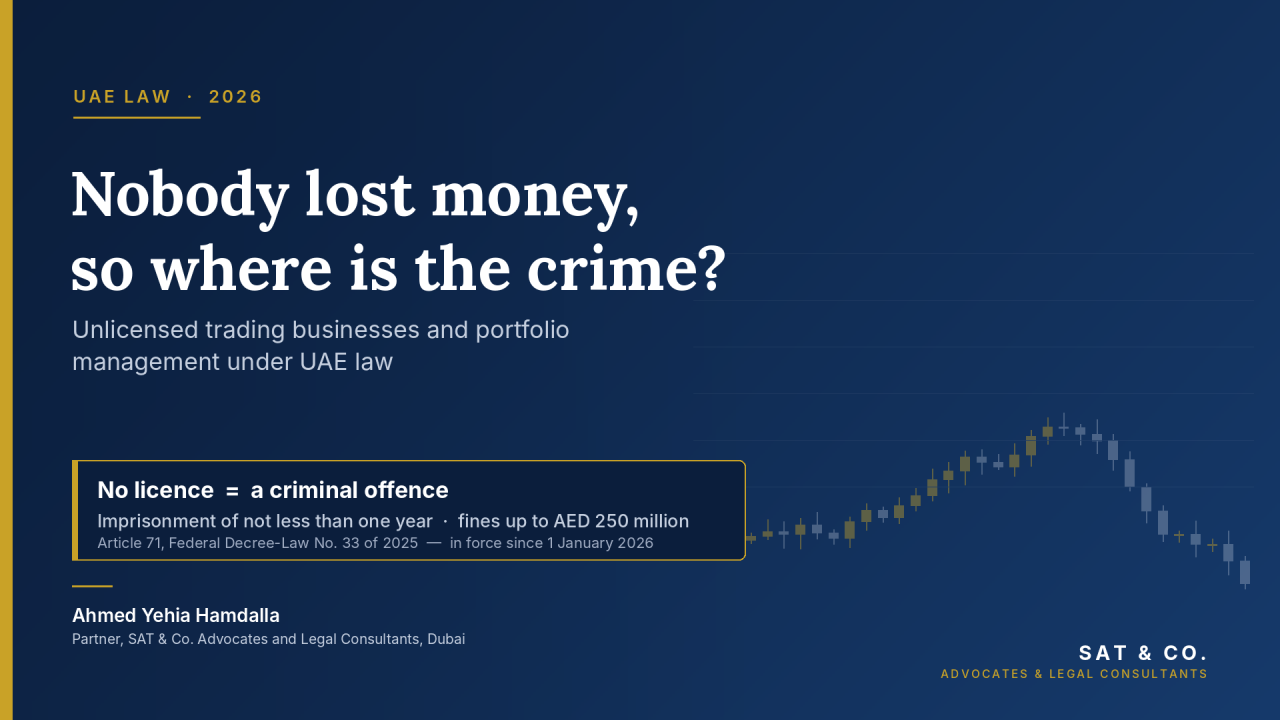
A trader with a good year behind him sets up a company, prints business cards that say "investment", opens a Telegram group and begins trading the accounts of a dozen acquaintances for a share of the profits. A finance professional "looks after" the portfolios of a few family friends for a monthly fee. A start-up builds an app that lets users copy its trades. None of them thinks of himself as a criminal, each holds a trade licence of some kind, and when regulation is raised the answer is always the same: nobody has been defrauded, so where is the crime? Under UAE law as it stands in 2026, the crime is the absence of the licence itself. No loss is required, no complaint is required, and the penalties were rewritten last year with imprisonment at their centre.
1. Two regulators:
Two federal laws now draw the perimeter. The first is Federal Decree-Law No. 33 of 2025 on the Regulation of the Capital Market, in force since 1 January 2026, which together with Federal Decree-Law No. 32 of 2025 replaced Federal Law No. 4 of 2000 and reconstituted the Securities and Commodities Authority as the Capital Market Authority. Article 3(1) lists the activities that require a CMA licence or approval, and the list reads like a description of the businesses above: brokerage, portfolio management, the establishment and management of funds, trading as a dealer in financial products, financial advisory services, promotion, "introducing" financial activities, and services related to virtual assets. Article 3(2) then states the rule without qualification: no person may carry out any of those activities within the State unless a licence or approval has been obtained from the CMA. The second is Federal Decree-Law No. 6 of 2025 regarding the Central Bank, in force since 16 September 2025. Article 60 prohibits any person from carrying on, or promoting, a licensed financial activity without a Central Bank licence; Article 61(1) extends that perimeter to deposit-taking, credit, currency exchange and money transfer, payment services, acting as principal in foreign exchange, derivatives, equities and commodities, and arranging, promoting or marketing any of those activities; and Article 62 applies the licence requirement regardless of the medium, technology or form employed, expressly including platforms and applications that facilitate investment services.
Three features of this framework catch those who believe a commercial licence is enough. Article 6(1) of the Capital Market Law provides that no legal person may be registered or licensed by the Ministry of Economy, the Central Bank or a local licensing authority to carry out a financial activity without the CMA's prior approval, so a "general trading", "consultancy" or "investment" licence from a Department of Economy or a free zone that never passed through the CMA licenses nothing in this field. Article 2(1)(d) brings within the law any person who targets clients within the State even from outside it or from a financial free zone, so a DIFC or ADGM licence, which authorises business in and from that zone under its own regulator, does not by itself authorise soliciting the onshore public. And the line that matters is other people's money: trading one's own capital through a licensed broker is not a licensed activity, but the moment a third party's funds are traded or pooled on one's decisions, or a third party is solicited to trade through one's company, the activity falls within Article 3 of the Capital Market Law or Article 61 of the Central Bank law.
2. What the penalties are
The Capital Market Law reserves its heaviest criminal provision for exactly this conduct. Under Article 71, anyone who engages in or practises any financial activity subject to the law, or performs any tasks or activities related to it, without a licence, approval, registration or accreditation from the CMA is punished by imprisonment for not less than one year and a fine of not less than AED 50,000 and not more than AED 250 million, or either of those penalties, and the offence is committed "whether the result is achieved or intended to be achieved". There is no element of loss and no element of deceit: the offence is complete when the unlicensed activity is carried on. Article 72 adds imprisonment of up to one year and a fine of up to AED 50 million for falsely presenting oneself as licensed by the CMA with intent to mislead, which is what a "regulated" badge on an unlicensed website amounts to. Article 73 allows the court to add a ban from the activity for up to five years, confiscation of the seized funds and publication of the judgment, and makes those measures mandatory on a repeat conviction. Article 74 extends the penalties to anyone who instigates, causes or participates in the offence, which reaches the marketer, the introducer and the partner who lent his name. The Central Bank law is no gentler: under Article 170 of Federal Decree-Law No. 6 of 2025, carrying on any of the activities listed in Article 61(1) without a licence is punished by imprisonment and a fine of between AED 50,000 and AED 500 million, or either.
The administrative track runs in parallel and does not wait for a court. Under Article 65 of the Capital Market Law the CMA may fine an unlicensed operator up to AED 200 million or ten times the profit made, suspend the activity and close the premises, seize funds, devices and systems, sanction the partners, directors and executives personally and refer them to the Public Prosecution, and under Article 58 it may ask the courts to freeze bank accounts, seize financial products and impose travel bans. The Central Bank, under Article 168 of its law, may fine any person carrying on or promoting financial activities without a licence not less than AED 1 million, order the return to customers of the funds obtained through the violation, fine the violator up to ten times the amount involved, and publish the decision with the violator's name. Where investors' money has in fact been lost, the unlicensed activity is charged alongside fraud under Article 451 or breach of trust under Article 453 of the Penal Code, Federal Decree-Law No. 31 of 2021, and the proceeds may be pursued under the anti-money-laundering law.
3. Enforcement, and what to do
None of this is theoretical. Through 2026 the CMA has issued a series of public warnings naming unlicensed platforms and firms, and on 3 June 2026 it announced fines of AED 5.5 million on companies carrying on unlicensed financial and investment activities, together with the closure of their offices and the blocking of their websites. The law gives the regulator a public register of persons found to be operating without a licence (Article 43), a power to inspect any entity suspected of unlicensed activity (Article 47) and a power to settle with the offender before criminal proceedings are opened (Article 75), failing which the file goes to the Public Prosecution. The one-year adjustment period in Article 83 gives persons subject to the law time to bring their position into line with its new requirements; the regulator's record this year shows it is not treating that period as a pause on action against those who were never licensed at all.
For anyone running or planning such a business the test is short: does the activity involve other people's money or other people's trades, and is there a CMA or Central Bank licence that covers it? If the first answer is yes and the second is no, the business has been a criminal offence since the day it started, and the options are to obtain the licence, to restructure as proprietary trading of one's own funds, or to stop. For investors the test is equally short: before transferring money to anyone who offers to trade or manage it, check the licence on the CMA's register, and treat the absence of one as the end of the conversation.
Conclusion
In the UAE the licence is not paperwork attached to a trading business; it is the line between a trading business and a crime. Under the laws now in force, managing another person's portfolio for a fee without authorisation carries imprisonment of not less than one year and a fine of up to AED 250 million, or either of them, and no one needs to have lost a dirham for that sentence to be available.