Original text
Full text
By Ahmed Yehia Hamdalla — Partner, SAT & Co. Advocates and Legal Consultants, Dubai
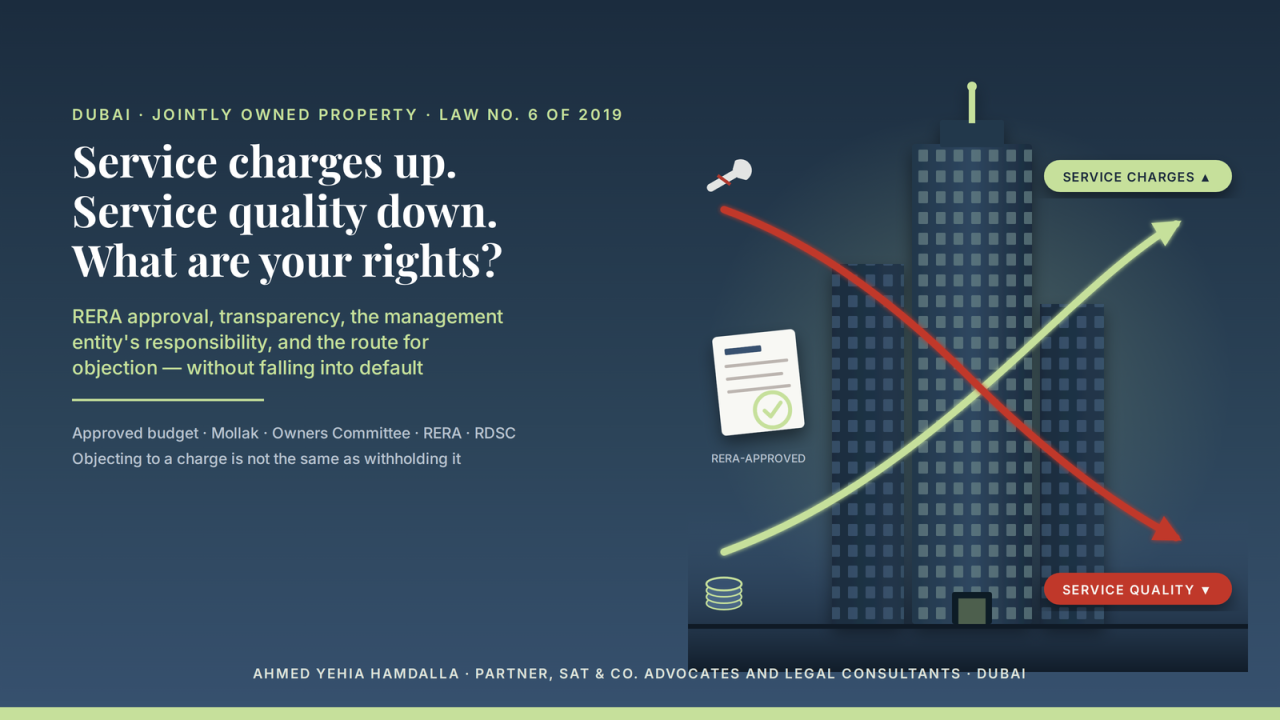
The invoice arrives through Mollak and the rate per square foot is higher than last year. In the same month one of the lifts has been out of service for weeks, the pool is closed "for maintenance", the corridors are cleaned less often and the security desk is unmanned at night. The owner's instinct is simple: why should I pay more for less, and can I hold back the money until the building is run properly? Dubai's Law No. 6 of 2019 Concerning Ownership of Jointly Owned Real Property gives that owner a great deal: a right to know exactly what is being charged and why, a regulator that audits the money and inspects the building, a committee of owners with a statutory voice, and a specialized judicial forum for every dispute under the law. What it does not give is a right to withhold charges that the regulator has approved. This article sets out how a service charge becomes payable, what transparency an owner is entitled to, who answers for the standard of service, how an objection or complaint is properly made, and why objecting to a charge and refusing to pay it are two different acts with very different consequences.
1. The framework: one law, one regulator, one forum
Law No. 6 of 2019 replaced the 2007 regime under which owners' associations were meant to run their buildings. It places the management, operation, maintenance and repair of the common parts in the hands of a "Management Entity", which, depending on the category of the project, is the developer, a hotel project management company or a management company operating under the supervision of the Real Estate Regulatory Agency (RERA). Owners are represented by an Owners Committee of up to nine members whose role is supervisory and advisory rather than executive. The money is regulated through Mollak, the Dubai Land Department's electronic system through which budgets are submitted and approved, invoices are issued, service charge accounts are monitored and audit reports are filed. And, under Article 42, the Rental Disputes Settlement Centre (RDSC) has exclusive jurisdiction over all disputes relating to the rights and obligations created by the law. Every right and every remedy discussed below sits within that architecture.
2. How a service charge becomes payable
The starting point is Article 25: each owner must pay to the Management Entity an annual share of the service charges needed to manage, operate, maintain and repair the common parts, calculated in proportion to the area of the unit relative to the total area of the property, and the developer bears the share attributable to unsold units. That obligation, however, is not open-ended. Article 27 provides that a Management Entity may not charge owners any service or usage charges without first obtaining RERA's approval, and that RERA may not approve a budget unless it has been reviewed by a certified audit firm; a temporary budget may be approved pending the full budget, under rules issued by the Director General of the DLD. The approved budget is then translated into invoices issued through Mollak, and the approved rate for each project, by usage type and year, is published in the DLD's Service Charge Index, which any owner can consult on the DLD website, on Mollak or in the Dubai REST application.
The law is equally specific about where the money goes. Under Article 30 the Management Entity must open a service charge account for each property with a bank licensed in Dubai and recognised by RERA, must deposit collected charges into it within seven working days, and may not use the funds for anything other than a closed list of purposes: cleaning, security and safety, the operation, maintenance, repair and improvement of the common parts, insurance premiums, audit fees, the management company's own fees at the level fixed by RERA, approved administrative expenses of the developer in major projects, a cash reserve for emergencies and replacement of equipment, RERA's inspection costs and other costs prescribed in the master community declaration and approved by RERA. The reserve must be kept in a separate account and may not be touched, other than in critical emergencies, without RERA's prior approval; and the service charge account may not be attached by the Management Entity's own creditors. The practical result is that a "service charge" in Dubai is a defined legal object: a sum derived from an audited budget, approved by a regulator, invoiced through a regulated system and spent from a ring-fenced account for enumerated purposes. An owner who understands that has already understood most of his rights.
3. Transparency: what an owner is entitled to know
Because approval by RERA is a condition of the charge, the owner is entitled to see the basis of the approval. Mollak gives registered owners access to their invoices, their payment history and the accounts of their property. The Service Charge Index gives them the approved rate against which any invoice can be checked. The Owners Committee, under Article 24, reviews the annual budgets and makes recommendations on them before they go to RERA, verifies that the Management Entity is complying with the law and the building management regulation, and receives owners' complaints. The Management Entity must, under Article 34, provide RERA every six months with a report on the management of the property and the maintenance works carried out, and must supply on request a statement of the revenue and expenditure of the service charge account; and RERA, under Article 33, audits the revenue credited to and the expenditure debited from that account, may demand any information or statements it requires, may engage a certified auditor to do so, and audits the contracts the Management Entity has concluded with its maintenance, security, cleaning and insurance contractors. An owner who is told that the increase is "due to rising costs" is therefore entitled to ask, and to be shown, which line of the approved budget has risen, what tenders supported it, what the audited accounts of the previous year showed, what the reserve fund holds and what the management fee is. A Management Entity that cannot answer those questions has a problem with RERA, not merely with the owner.
4. The Management Entity's responsibility for the standard of service
The charge is paid for a service, and the law makes the Management Entity answerable for delivering it. It is the party charged with the management, operation, maintenance and repair of the common parts and the utility services; it must conclude the contracts needed to perform those duties; it must insure the property against damage and destruction; and it is subject to RERA's power under Article 33 to inspect the property, to verify that the common parts are fit for their intended purpose, to record violations where the property is not kept in good condition, to serve notices on the Management Entity and to set deadlines for the violations to be remedied. RERA also considers complaints filed against developers, Management Entities and Owners Committees concerning the management, operation, maintenance and repair of the property and takes the action it considers necessary. Where the Management Entity is a management company appointed under RERA's supervision, the Owners Committee may request RERA to replace it; where the project is managed by the developer or a hotel management company the route is narrower and depends on a finding by the DLD that the entity is not competent. Breaches of the law and its implementing resolutions attract administrative fines that may reach one million dirhams, doubled for a repeat violation within a year up to a ceiling of two million dirhams. And the general law of obligations remains in the background: a Management Entity whose negligence in maintaining a common part causes damage to a unit, for example a failed riser that floods an apartment, is liable to the owner for that damage, and the claim lies before the RDSC. It is worth adding a distinction that is often missed: defects in the original construction are the developer's responsibility under the decennial liability rules of the Civil Transactions Law and are not cured by the service charge, while the failure to maintain what was properly built is the Management Entity's responsibility and is exactly what the service charge pays for.
5. The route for objection and complaint
The law sets out a sequence, and an owner who follows it will be taken seriously at each stage. The first step is a written complaint to the Management Entity itself, identifying the failure precisely, with dates and photographs, and, where the complaint concerns the amount of the charge, identifying the line of the budget that is challenged. The second step is the Owners Committee: a complaint submitted to the committee that the Management Entity fails to address within fourteen days may be referred by the committee to RERA, which is why the complaint should be dated and a copy kept. The third step is a complaint to RERA directly, through the DLD's channels, including the Dubai REST application and the DLD website; RERA may inspect, audit, record a violation and set a deadline for its remedy, and its findings carry weight in any later proceedings. The fourth step is a claim before the RDSC, which may order the Management Entity to perform its obligations or to compensate the owner for loss caused by its failure to do so. For objections to the amount of the charge, the most effective moment is before approval, through the Owners Committee's review of the annual budget; after approval, the objection takes the form of a complaint to RERA against the approval or the way the approved funds are being spent. There is one situation in which an owner may properly decline to pay: where the charge demanded has not been approved by RERA at all, or falls outside the approved budget. The obligation in Article 28 attaches to charges "approved by RERA", and a Management Entity that invoices anything else is in breach of Article 27 and should be reported.
6. Objecting is not withholding
This is the point on which most owners go wrong. Article 28 provides that an owner may not refrain from paying the service charges approved by RERA, and may not waive his interest in the common parts in order to avoid the charges due from him. The DLD's guidance has long said the same thing in practical terms: the invoices approved by RERA are the reference point in any dispute over the charges, and the owner's complaints about the quality or the value of the services are matters for the complaint and dispute machinery, not grounds for non-payment. The RDSC applies that obligation strictly; in October 2025 its General Assembly for the Unification of Principles held that a purchaser registered in the preliminary register of a unit is liable for service charges from the date of completion of the building, or from the date of his default in paying the balance of the price, whether or not final registration or handover has taken place. Nor does the general law offer an escape through set-off: a debt can be set off only against a debt that is itself due and ascertained, and an owner's claim that the service has been deficient is, until it is quantified and upheld, neither. An owner who deducts from the invoice what he considers the service to have been worth has not exercised a right; he has defaulted.
The consequences of default are laid down in Article 32. The Management Entity has a lien over the unit for the unpaid charges. It serves a written notice giving thirty days to pay; if the charges remain unpaid, the claim is enforceable before the execution judge of the RDSC, the unit may ultimately be sold at public auction to recover the charges, and the defaulting owner bears the court and advocates' fees incurred. In practice a transfer of the unit cannot be registered until the Management Entity confirms that the charges are clear, so the arrears will also surface at the moment the owner wishes to sell. The law does, however, protect the owner against self-help by the other side: under Article 29 a developer or Management Entity may not take any action to prevent an owner from taking possession of or using his unit, the common parts or the common facilities in order to force him to pay, otherwise than through the procedures the law prescribes. The disconnection of access cards, the withdrawal of parking or the barring of the pool as a collection device is a breach of the law and should itself be reported to RERA.
The correct course for an owner who believes the charge is too high or the service too poor is therefore to pay the approved invoice under a written reservation of rights, to pursue the complaint route described above, and, if the complaint is not resolved, to claim before the RDSC for the remedy the law provides. Where the difficulty is cash flow rather than principle, instalment arrangements, which a number of management entities have offered under a DLD-backed initiative since 2025, are a far better answer than arrears. An owner who pays and complains keeps every right the law gives him and adds to them the credibility of a party who has performed his own obligation; an owner who withholds hands the Management Entity a lien, a notice and an execution file, and converts a legitimate grievance about the service into a straightforward claim against himself.
7. A short checklist for owners
Before challenging a charge, check the approved rate for the project in the Service Charge Index and compare it with the invoice. Ask the Management Entity, in writing, for the approved budget, the audited accounts of the previous year, the tenders supporting the main cost lines, the reserve fund balance and the management fee. Record every service failure as it occurs, with dates, photographs and the reference of the complaint made. Route complaints through the Owners Committee and keep a dated copy so that the fourteen-day period can be proved. Escalate to RERA through the DLD's channels when the Management Entity does not respond, and to the RDSC when the failure persists or has caused loss. Pay the approved invoice on time and under reservation, refuse only what RERA has not approved, and never treat non-payment as a form of protest.
Conclusion
Law No. 6 of 2019 struck a deliberate balance. It took the running of buildings away from owners' associations that often could not function, placed it with professional Management Entities under a regulator's supervision, and in exchange gave owners transparency over the money, a statutory voice through the Owners Committee, a regulator with real powers of audit and inspection, and a specialised forum for every dispute. The price of that balance is that the approved service charge is paid whatever the owner thinks of it, and that the owner's disagreement is pursued through the channels the law created rather than by withholding. An owner who uses those channels well, with documents, dates and the approved budget in hand, will usually find that a rising charge for a falling service is a case that can be won; an owner who simply stops paying will find that the only case being heard is the one against him.
Sources: Law No. (6) of 2019 Concerning Ownership of Jointly Owned Real Property in the Emirate of Dubai, in particular Articles 24, 25, 27, 28, 29, 30, 32, 33, 34, 42 and 44 (English text as published on the Dubai Legislation Portal); Dubai Land Department, Service Charge Index and the Mollak system (dubailand.gov.ae); DLD statement of 6 January 2020 on the obligation of owners to pay service and usage charges for jointly owned property; Rental Disputes Settlement Centre, principle announced on 2 October 2025 by its General Assembly for the Unification of Principles on the liability for service charges of purchasers registered in the preliminary register.
This article is general commentary and not legal advice on any specific property or dispute.